No. 52. of the Capacity Assessment of Corroded Reinforced Concrete Structures - Books of abstracts for the CACRCS Days 2020. 01-04 December 2020 - Online event PDF format Edited by: Beatrice Beletti, Dario Coronelli
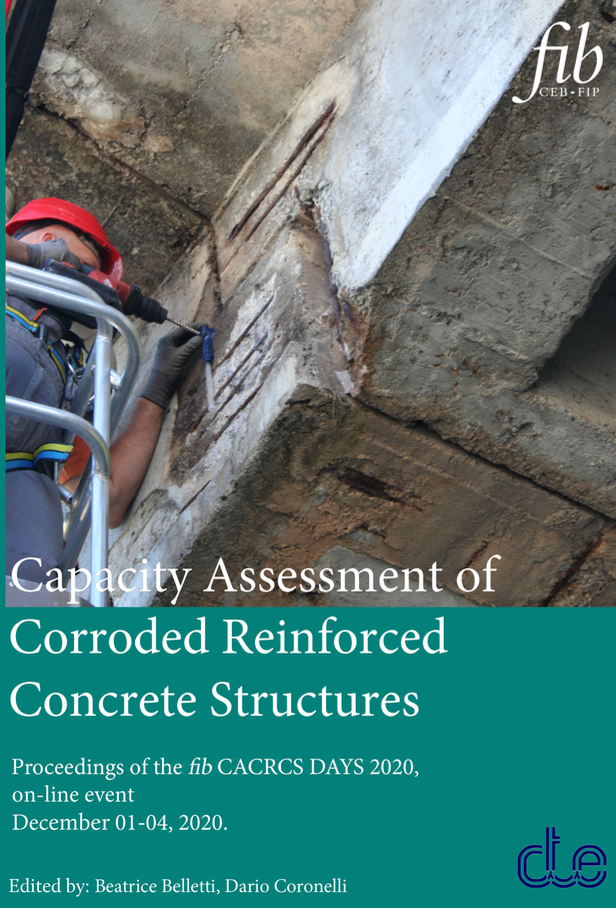
The fib CACRCS Workshop has reached its second edition. The first CACRCS Days workshop in 2019 was held in Parma, in northern Italy, as part of the initiatives arising from a research project funded by the Italian Ministry of Education and Research (2017–2020) on “Failure mechanisms due to lack of construction details and degradation phenomena in existing reinforced concrete buildings.”
The online workshop organised this year shows a marked increase in participation, with the number of papers rising from 15 in 2019 to 56 in 2020, and a total of 148 authors contributing. While the first edition primarily involved European participants, the international reach has now expanded to include contributions from the Americas, Asia, and Australia.
It is important to emphasise that addressing issues related to the capacity assessment of corroded structures requires multidisciplinary approaches, reflected in the authors’ affiliations. The two main disciplinary backgrounds are civil and structural engineering and chemistry. Most authors are affiliated with universities, but contributions also come from private companies, research institutions, and transport authorities.
The keynote lecture on fib Model Code 2020 outlines efficient procedures for structural assessment on the path towards a sustainable future for concrete structures. The effective performance of such structures contributes to quality of life and safety worldwide. In order to mitigate the effects of climate change, resilient structures are required, and global development depends on efficient and sustainable infrastructure.
The assessment of corrosion processes and morphology is the focus of Session A1. The fundamentals of corrosion processes are presented in the keynote lectures, while chemical studies extend to the propagation phase of corrosion. In particular, natural, accelerated, and artificial corrosion processes are analysed in relation to corrosion products, the morphology of corroded reinforcement bars, and the resulting mechanical response, including the development of internal pressures that lead to cracking and spalling of the concrete cover. The aim is to achieve a deeper understanding of the differences between these processes and their consequences for structural performance assessment.