No. 38. - Engineering a Concrete Future: Technology, Modeling & Construction. - 12th fib Symposium Proceedings - 22-24 April 2013 - Tel-Aviv, Israel PDF format
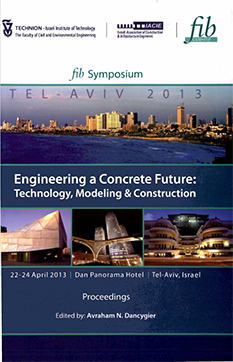
In a general sense, the meaning of “engineering a concrete future” is to plan ahead in order to bring about a solid and stable future. Indeed, the actual use of concrete in the construction of infrastructure also gives this statement a practical meaning.
Traditionally, civil — and in particular structural — engineering may appear to develop in a conservative, step-by-step manner. However, when considering the consequences of applying innovative ideas and concepts in this field, advances in structural engineering are keeping pace with other developments that have been changing the world dramatically over recent decades. Because of these consequences, results of research in areas such as new building materials, and their application in structural modelling and in real structures, must undergo careful and extensive verification processes before being implemented.
Improved concrete engineering has been reflected both in innovative ideas and, as stated in the resolution of the recently approved Model Code 2010 (regarding the shear section): “The models presented in this section represent an advance in philosophy towards more physically based models. The change is made at this time in recognition of the maturity of the new methods and of their capacity for further development, using a consistent framework, over future years.”
Research in structural concrete over the last four to five decades has focused on various topics. These include a better understanding of punching and shear behaviour, improved design of large structures such as high-rise buildings and bridges, resistance of structures to extreme loads caused by earthquakes, impact, or explosion, as well as developments in construction methods such as precast structures. Progress has also been made in the development and application of high-strength and high-performance concrete in building structures.
Innovative aspects and developments in concrete engineering at various stages are the theme of this Symposium, titled “Engineering a Concrete Future: Technology, Modelling and Construction.” Its scope also includes topics in several distinct areas of interest. All papers in the Symposium’s nine topics have been reviewed by members of the Scientific Committee, whose professional contribution is highly appreciated.
Special thanks are due to Prof. Frank Dehn, Prof. Manfred Curbach, Dr. Itai Leviathan, Prof. Stephen Foster, Dr. Jean-François Klein, Prof. Marco Menegotto, Prof. Michael Fardis, Prof. Josée Bastien, and Prof. Alberto Meda, who agreed to serve as Lead Reviewers and to oversee the review process of contributed manuscripts in the nine Symposium topics.
Last but not least, we extend our sincere and deep appreciation to the members of the Organising Committee: Mrs. Inbal Cabiri, Eng. Danny Marian, Eng. Arie Lowenton, and Dr. Itai Leviathan from IACIE, as well as Dr. Petra Schumacher, Secretary General of fib.
Tel Aviv, April 2013
Avraham N. Dancygier
Chairman of the Organising Committee
Gordon M. Clark
President of fib