No. 74. Structural Concrete 2050 Towards Carbon Neutrality, AI Design, and Robotic Construction - 7th fib Congress Proceedings - 15-19 June 2026 - Lisbon, Portugal - PDF format
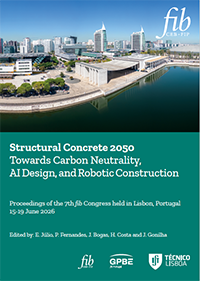
Following the organisation of the fib Symposium 2021, which was held online due to the COVID-19 pandemic, and in the year in which the Portuguese Group of Structural Concrete (GPBE – fib Portugal) celebrates its 60th anniversary, it is our great pleasure and honour to welcome you to the 7th fib Congress, Lisbon 2026.
Organised every four years by fib – the International Federation for Structural Concrete – this congress brings together professionals, researchers, and students from around 100 countries to discuss the latest advances in structural concrete. Under the theme “Structural Concrete 2050: Towards Carbon Neutrality, AI Design, and Robotic Construction”, the 2026 edition aims to foster discussion on sustainability and on the opportunities offered by emerging technologies for the future of structural concrete, while strengthening the bridge between research and practice (the fib motto).
The Congress is co-organised by GPBE and Instituto Superior Técnico – University of Lisbon (IST-UL). The event takes place both at the Culturgest Congress Centre, featuring a main auditorium with capacity for more than 600 participants, a smaller auditorium, and six additional meeting rooms, and at IST-UL, namely at the Civil Engineering Museum – hosting the exhibition “Portuguese Bridges: A Tribute to Edgar Cardoso” during the Congress – as well as in three additional auditoria. Altogether, the facilities accommodate up to 12 parallel sessions.
The technical programme is organised into six main topics, covering all subjects currently of greatest relevance in the field of Structural Concrete: Topic 1: Materials for Structural Concrete, Topic 2: Construction and Prefabrication, Topic 3: Design & Analysis, Topic 4: Existing Concrete Structures, Topic 5: Projects, Works and Case Studies, and Topic 6: Codes, Standards, Pre-Norms & Guidelines.
Over 1,100 abstracts were submitted from all over the world and were reviewed by most of the around 300 members of the Scientific Committee according to their fields of expertise. Subsequently, the corresponding full papers were submitted and also peer-reviewed by the Scientific Committee. In the end, around 840 papers were accepted for publication in these proceedings and for presentation across 150 parallel sessions.
These proceedings are organised into several sections. They begin with the eight keynote lectures – presented in formats ranging from extended abstracts to full-length papers – followed by the papers included in the 42 special (thematic) sessions, and finally by the papers presented in the remaining 108 parallel sessions, organised according to the six topics mentioned above.
Finally, I would like to express my sincere gratitude to all members of the Organising Committee for their dedication and hard work, to the members of the Scientific Committee for their valuable reviews, which contributed significantly to improving the quality of the papers, to the authors for their excellent papers and presentations, to the delegates for enriching the scientific and technical discussions, and to the sponsors for their support of this event and for showcasing their products and services in the Technical Exhibition.
Eduardo Júlio
President of GPBE and Chair of the Organising Committee